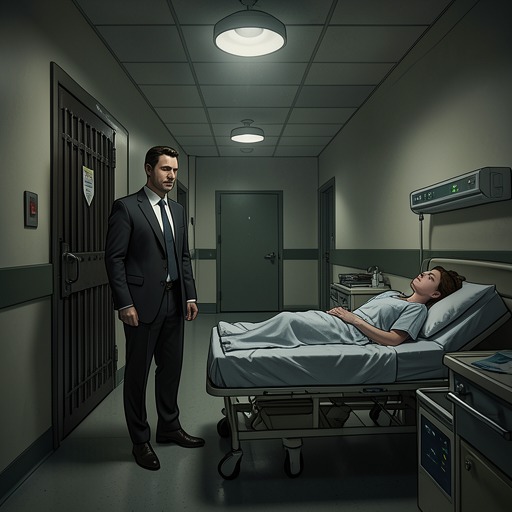
End-Stage Renal Disease
I'm Still Here- What didn't kill me made me stronger and sharperEnd-Stage Renal Disease is the condition that turns Gloria Simpson Picou’s estrangement from Jensen Brick McCall into an immediate question of care. Gloria needs a kidney transplant and faces steep medical bills; Jensen initially refuses to help the mother he holds responsible for his abandonment. Their later reconciliation changes the meaning of that refusal: he ultimately donates a kidney so she can live to watch her younger children grow up. The novel does not describe the medical procedure or establish the long-term clinical outcome, but it makes the donation a consequential act within a family story shaped by illness, secrecy, and loss.
Diagnosis and Family History
The condition enters the plot through a fundraiser organized by Ginger Pearl for someone close to her who is seriously ill. She asks Jensen and Janae Morrison to help, and Jensen offers before learning who the fundraiser is for. When Ginger Pearl identifies the patient as his mother, he shoves his plate aside and glares at her. The disclosure makes clear that this is not an abstract request for charity: the person needing help is the mother whose rejection remains central to his history.
Gloria’s illness is presented as end-stage renal disease, not as a passing health concern. Jensen notices the diagnosis on her medical alert bracelet, then asks whether she receives dialysis. Gloria says she goes three times a week and has done so for three years. Those specific details give the disease an ongoing place in her life: dialysis is a repeated part of her routine, and the need for a transplant makes the family’s decision urgent. The account offers no further medical explanation, keeping its attention on what the diagnosis means for the people facing it.
The conversation also touches on a history of illness and neglect within Gloria’s family. She says she was raised to keep family matters secret and not disrupt the household, and that her mother focused on a sick brother while failing to notice her. Gloria adds that she had the same disease as him. The text does not name the uncle’s illness, but places Gloria’s account of being overlooked beside the bracelet identifying her condition. Her experience of disease is thus bound up with the family’s failure to recognize her needs, even as her own illness now requires care from the son she once failed to acknowledge.
The Request and Jensen’s Refusal
Jensen’s first response to the transplant appeal is an emphatic no. He says Gloria would not even acknowledge that he was alive and objects to being asked to do the right thing for someone who did not do right by him. The request exposes the moral pressure surrounding the illness: Ginger Pearl presents helping Gloria as an act of goodness, while Jensen insists that the language of duty cannot erase what happened between mother and son.
That history is severe. Jensen understands Gloria as his murderer because, after a botched abortion at twenty-six weeks, he survived and was left on a table to die. Grace McCall, the nurse who first cared for him, saved his life; when she told Gloria the baby was still alive, Gloria told them to let him die. Against that account, a request that he help preserve Gloria’s life carries a particular force. His refusal is not simple indifference to a stranger’s illness: he sees the transplant appeal through the wound of having been denied recognition and care by the person who now needs them.
Ginger Pearl asks him to hear her out, and he allows her to explain the need for a transplant and the high bills, but he maintains that he will not help. She suggests that doing good might help Gloria see him. The exchange leaves the central conflict unresolved: an appeal to compassion cannot itself repair the relationship, and Jensen does not accept the idea that generosity will compel his mother to recognize him. At this stage, the disease makes the cost of estrangement visible without immediately overcoming it.
Disclosure, Reconciliation, and Care
The medical alert bracelet becomes part of a different encounter between Jensen and Gloria, one in which he asks about her treatment directly. His questions establish the regularity and duration of her dialysis, while her answers make the extent of her illness concrete. The scene follows a conversation in which Gloria speaks about family silence and about being overlooked; Jensen tells her that he needed to hear her apology and that he cannot make her love him as her son. His acknowledgment of the illness therefore does not erase the injury or instantly restore trust.
Instead, the reconciliation remains measured. After hearing Gloria’s account, Jensen lets go of her hand, notices the bracelet, and asks about dialysis. He later tells her that he wants to get to know her but needs time. That boundary matters: recognition of her medical vulnerability does not require him to pretend their history is settled. The illness places them in the same conversation, but the relationship must still be rebuilt through honesty and time rather than assumed from their biological connection.
The contrast between the earlier refusal and the later outcome gives the disease its larger narrative weight. Jensen’s eventual donation does not make the original abandonment disappear, nor does the novel frame the operation as proof that Gloria’s actions were harmless. Rather, his decision follows a change in their relationship and in his willingness to act within it. The story moves from a request he rejects because it seems to demand care without recognition to a choice he makes after he has begun to establish what kind of relationship he can have with his mother.
Donation and Significance
One year later, at the family gathering on Christmas Day, Jensen says that he has given Gloria his kidney so she can watch his brother and sister grow up. The donation is presented alongside the birth of his daughter and his description of Gloria as his mother now, a striking reversal from his earlier insistence that she had not acknowledged him. The account does not say when the transplant occurred, describe its medical course, or state that Gloria is cured. It does show that Jensen has taken a direct bodily action to extend her chance of being present for her other children.
The disease thus connects private suffering to the possibility of a reconstructed family. Gloria’s need for a kidney first confronts Jensen with the past: the mother asking for help is also the mother he believes tried to end his life. His eventual donation does not cancel that past; it changes what he chooses to do in its shadow. At the Christmas table, illness and kinship no longer appear only as evidence of abandonment and neglect. The kidney donation becomes an act of care within a family that Jensen has come to claim, while leaving the story’s emphasis on relationship and chosen responsibility rather than on a medical outcome it does not specify.